Facebook
 X
X
 Pinterest
 Copy Link
You’ve saved for the down payment. You’ve gotten pre-approved. You’ve found the house.
And then someone mentions closing costs.
For many buyers, especially first-time buyers, this is the part of the purchase that can feel surprisingly confusing. There are lender fees, title charges, escrow costs, prepaid taxes, insurance, recording fees—and suddenly it seems like everyone involved in the transaction has another line item.
The good news is that closing costs become much easier to understand once you separate them into three categories:
Costs you should expect. Costs you may be able to shop around for. And costs that may be negotiable with the seller.
If you’re buying a home in San Jose or elsewhere in Santa Clara County, here’s what you should know before you get to the closing table.
First: Closing Costs Are Separate From Your Down Payment
This is probably the most important thing for buyers to understand.
Your down payment and your closing costs are two different buckets of money.
Your down payment goes toward purchasing the home. Closing costs cover many of the services, fees, taxes and prepaid expenses necessary to complete the transaction and establish your mortgage.
Rather than relying on a generic percentage to determine exactly how much cash you’ll need, ask your lender for a detailed Loan Estimate early in the process. Your actual amount can vary significantly depending on your loan, purchase price, insurance, prepaid expenses and negotiated credits.
That conversation should happen before you start writing offers—not after you’re already in escrow.
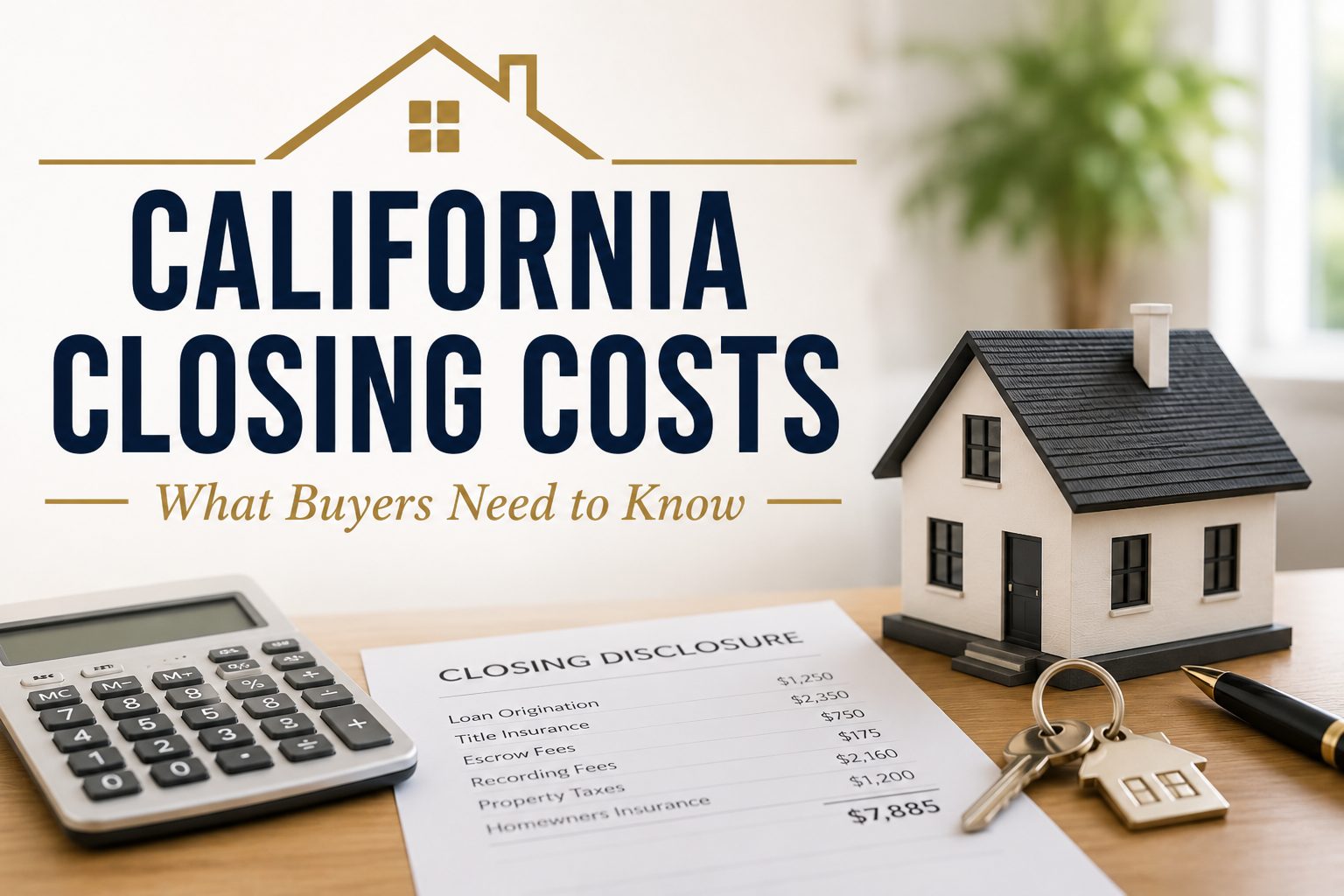
What Do California Buyers Usually Pay at Closing?
Depending on the transaction, a buyer’s costs may include:
- Loan origination and other lender fees
- Appraisal fees
- Credit-report charges
- Escrow fees
- Title insurance
- Recording charges
- Prepaid mortgage interest
- Homeowners insurance
- Property-tax adjustments or impounds
- Other loan-specific charges
Not every buyer will have exactly the same expenses.
A cash buyer, for example, won’t have mortgage-related fees. A buyer with an impound account may need additional funds collected at closing for taxes and insurance.
That’s why I always encourage buyers to look at their actual numbers rather than somebody else’s closing statement.
Title Insurance: One of the Most Confusing Expenses
Title insurance is an area where California buyers often have questions because customs vary depending on where you’re purchasing.
There are generally two policies involved when you’re financing a home.
A lender’s title policy protects your mortgage lender.
An owner’s title policy protects your ownership interest in the property.
In Northern California, it has traditionally been common for buyers to pay the owner’s title insurance premium, although practices vary and the parties can negotiate a different arrangement. California’s Department of Insurance specifically notes that who pays the title premium is based on local custom rather than state law.
That’s an important distinction.
Just because something is customary doesn’t necessarily mean it’s required.
Title insurance pricing isn’t something you simply bargain down at the closing table, either. California title companies file their rates and rate modifications with the Department of Insurance. However, companies can have different filed rates, so buyers can compare providers and ask about available discounts or concurrent-policy pricing.
Escrow Fees May Also Be Negotiable
Escrow is the neutral process that handles money and documents during the transaction.
The escrow holder may coordinate funds, documents, prorations, recording and the final accounting needed to complete the sale.
Who ultimately pays particular escrow charges can depend on the purchase agreement and local practice.
That means this is another area buyers should understand before writing the offer.
In a highly competitive multiple-offer situation, asking a seller to absorb additional expenses may make your offer less attractive.
But on a property that’s been sitting on the market—or where the seller is motivated—you may have considerably more room to negotiate.
That’s where strategy matters.
What About Transfer Taxes?
This is where things get especially local.
Santa Clara County currently lists a county documentary transfer tax of $0.55 per $500 of consideration or value transferred. For properties in San José, an additional city conveyance tax of $1.65 per $500 applies.
San José also has its Measure E Real Property Transfer Tax for qualifying higher-value transfers. The threshold is adjusted for inflation, so buyers and sellers dealing with properties near or above the applicable threshold should confirm the current amount rather than relying on an older article or calculator.
The tax itself is established by law. But who is responsible for a particular transaction expense should be confirmed through the purchase contract, escrow instructions and current local requirements.
That distinction is important: the amount of a government tax isn’t something your agent can negotiate away.
Recording Fees Are Another Government Charge
Certain documents associated with your purchase must be officially recorded.
Santa Clara County publishes its current recording fees, and the exact amount can depend on the document and applicable exemptions or additional charges.
This isn’t usually where you’re going to find meaningful savings.
Instead, buyers should concentrate on the expenses where they actually have options.
Where Buyers May Have Negotiating Power
This is the part buyers tend to find much more interesting.
Depending on your loan program, contract and the seller’s willingness to negotiate, you may be able to request a seller credit toward allowable closing costs.
That credit might help with certain lender costs, prepaid expenses or other permitted closing expenses.
In some situations, buyers may also negotiate for a seller-funded interest-rate buydown.
But there’s an important catch:
Your negotiating leverage depends on the property and the market.
Imagine two San Jose homes.
One hits the market on Thursday, has a packed weekend of showings and receives multiple strong offers.
The other has been listed for several weeks and the seller is ready to make a deal.
I probably wouldn’t approach those two negotiations the same way.
A good buyer strategy isn’t simply, “Ask the seller to pay closing costs.”
It’s asking:
Where do we have leverage, and what’s the smartest way to use it?
Don’t Forget About Prepaid Expenses
Here’s another place buyers get confused.
Some of the cash you’re asked to bring to closing isn’t technically a “fee.”
For example, your lender may collect money for homeowners insurance, property taxes or prepaid mortgage interest.
That money isn’t necessarily being charged because someone performed another service. Some of it is being collected in advance to cover expenses you’ll owe as a homeowner.
This distinction matters when you’re reviewing your Loan Estimate and Closing Disclosure.
Don’t just look at the giant number at the bottom.
Ask your lender or escrow officer to walk you through what each line means.
You are entitled to understand where your money is going.
Can You Shop Around for Closing Services?
In some cases, yes.
The California Department of Insurance encourages consumers to compare title insurance companies because filed rates and services can differ. It also notes that consumers may use one company for escrow services and another for title insurance.
Your lender is another important place to comparison shop.
When you’re comparing mortgage offers, don’t look at the interest rate alone.
Compare the interest rate, APR, lender fees, discount points, credits and estimated cash required at closing.
A lender advertising a slightly lower rate isn’t necessarily offering the less expensive loan if you’re paying thousands of dollars more upfront to obtain it.
One More Tip: Pay Attention to Your Closing Date
Your closing date can affect certain prepaid expenses.
For example, mortgage interest is generally collected for the remaining days of the month after closing. That means a closing later in the month may require fewer days of prepaid interest at closing than an earlier closing.
That doesn’t automatically make a late-month closing “better.” Your moving schedule, seller’s needs, rate lock and other factors can matter more.
But it’s another good example of why two buyers purchasing similarly priced homes can have different amounts due at closing.
Fair Housing and Closing Costs
Every buyer deserves equal access to information, financing opportunities and the negotiation process.
Your race, color, religion, sex (including gender identity and sexual orientation), disability, familial status or national origin should never determine whether you’re shown certain homes, encouraged or discouraged from particular neighborhoods, or treated differently during the transaction.
Your offer strategy should be based on things that actually relate to the transaction—your financing, budget, goals, the property, market conditions and the terms you’re comfortable offering.
The same principle applies when discussing seller credits and closing costs.
What I Tell My Buyers
Don’t wait until you’re in escrow to figure out how much money you’ll need.
Before we start seriously looking at homes, I want buyers to understand three numbers:
How much cash do you need for your down payment?
Approximately how much should you reserve for closing and prepaid expenses?
How much cash do you want left after you get the keys?
That third number matters more than people realize.
Buying a home shouldn’t leave you completely cash-strapped the day you move in. Houses have an annoying habit of needing something approximately five minutes after you become responsible for them.
Planning for closing costs early gives you room to make better decisions later.
Bottom Line
Closing costs aren’t one giant mysterious fee.
They’re a collection of lender charges, title and escrow expenses, government fees, taxes, insurance and prepaid costs—and some parts of that equation offer considerably more flexibility than others.
For San Jose buyers, the key is understanding the numbers before you write an offer.
Some expenses are established by government rules. Some services can be comparison-shopped. And depending on the home and current market conditions, some costs may potentially become part of your negotiation with the seller.
If you’re planning to buy in San Jose, Willow Glen, Almaden Valley, Cambrian, Rose Garden, Japantown or another Santa Clara County community, I can help you look at the entire financial picture before you start making offers—not just the purchase price.
Because knowing what you can afford to buy is important.
Knowing what it will actually cost to close is just as important.