Facebook
 X
X
 Pinterest
 Copy Link
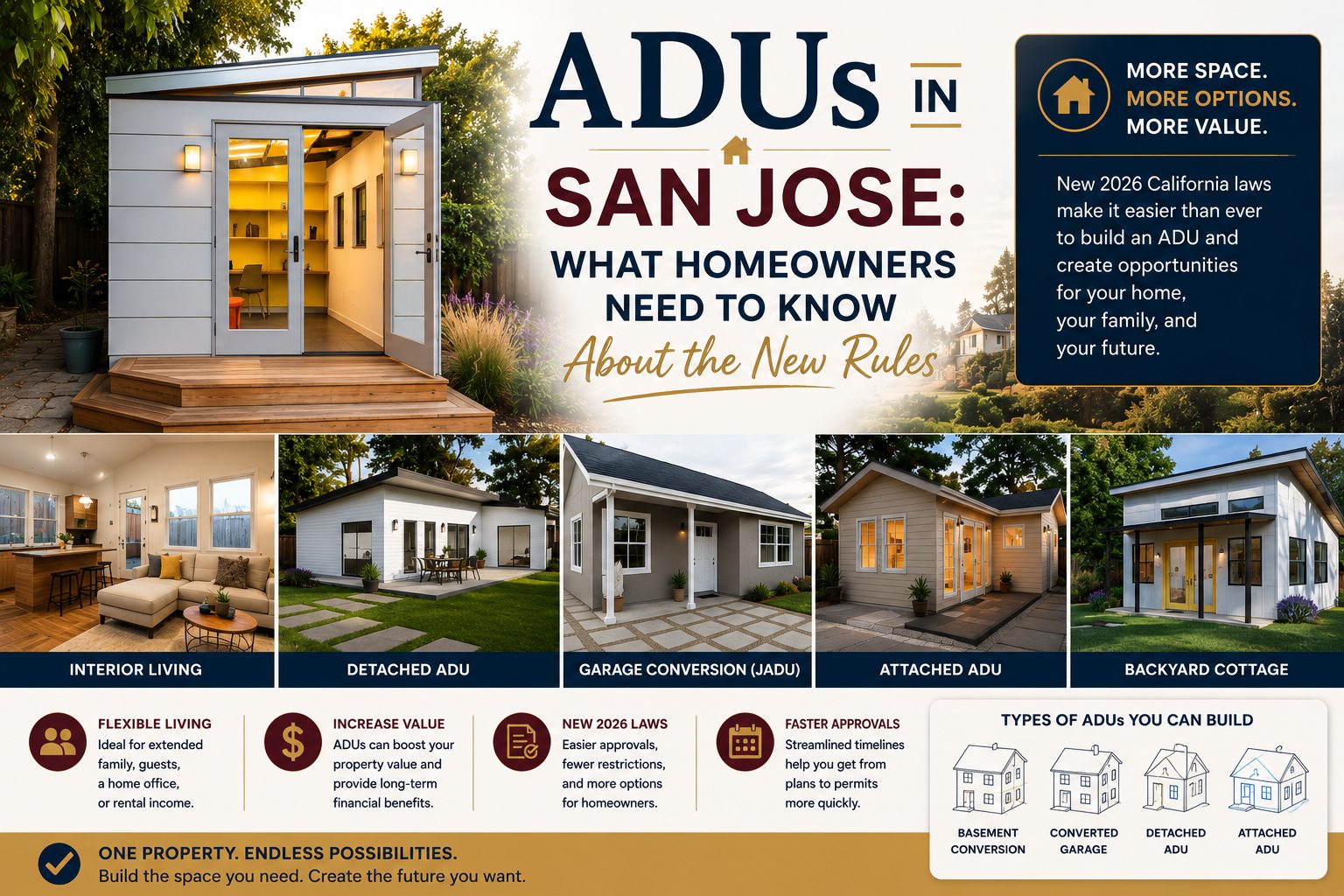
If you’re considering buying a home in San Jose—or already own one—an Accessory Dwelling Unit may open up possibilities you hadn’t considered.
Maybe you’d like additional living space. Maybe you’re thinking about long-term rental income. Or perhaps you simply want a property that gives you more flexibility as your needs change over time.
Whatever the goal, California has continued to expand ADU opportunities, and San Jose has its own permitting process and resources for homeowners considering a project. But an ADU isn’t automatically right for every property—or every budget.
Here’s what to know before you start planning.
First, What Exactly Is an ADU?
An Accessory Dwelling Unit, or ADU, is an independent residential unit located on the same property as another residence. In San Jose, ADUs can take several forms, including detached units, attached additions, and conversions of spaces such as garages or basements.
You may also hear about a Junior Accessory Dwelling Unit, or JADU.
In San Jose, a JADU is less than 500 square feet and is created within the footprint of a single-family home, which can include conversion of an attached garage. The requirements for JADUs differ from those for standard ADUs, so don’t assume the rules are interchangeable.
Why Buyers Should Pay Attention to ADU Potential
Even if you aren’t planning to build immediately, ADU potential can be worth investigating while you’re shopping for a home.
An ADU could potentially provide:
- Additional independent living space
- Long-term rental income
- A separate workspace
- Guest accommodations
- Greater flexibility as your housing needs change
The key word is potentially.
Not every lot works equally well for an ADU, and what can actually be built depends on the property’s characteristics, applicable zoning and building requirements, fire considerations, utilities, and the type of project you’re proposing.
San Jose recommends starting with its ADU Universal Checklist to determine whether a property and proposed project meet applicable requirements.
Can You Build an ADU on a Rental Property?
This is an area where California’s rules have changed significantly.
San Jose currently confirms that an ADU can be built on a property where the single-family home is already being used as a rental. The City also allows the primary residence and ADU to be rented to different parties.
JADUs have separate requirements, however, including rules concerning owner occupancy that depend on the configuration of the unit. Because those requirements have recently changed, verify the current rules for your specific JADU proposal before moving forward.
If rental income is an important part of your financial plan, confirm both the permitting requirements and rental restrictions before assuming a particular income stream.
ADUs and Fair Housing Laws
If you’re planning to rent an ADU, becoming a housing provider comes with responsibilities.
San Jose specifically notes that ADU rentals must comply with applicable fair housing laws. Rental advertising, applicant screening, lease terms, and availability cannot unlawfully discriminate against protected classes. The City also notes restrictions involving housing vouchers and that ADUs cannot be rented for terms shorter than 30 days under applicable state law.
For homeowners considering rental use, it’s a good idea to understand these obligations before advertising the property or screening applicants.
What About Permitting?
California has worked to streamline ADU approvals, but I wouldn’t describe every ADU as a “fast permit.”
The timeline depends on your project and whether the application is complete.
San Jose has a dedicated ADU permitting process, and the City also offers preapproved ADU plans. For qualifying projects using those plans, San Jose says same-day permit issuance may be available when the site-specific plan and required documents are accurate and complete.
That’s an option worth exploring if construction speed and reducing design complexity are priorities.
Already Have an Unpermitted ADU?
This is another area where I’d be much more specific than the original article.
San Jose now has an AB 2533 ADU and JADU Legalization Program, which provides a path for certain unpermitted units built or converted before January 1, 2020.
It isn’t an automatic approval.
The property owner must be able to demonstrate when the unit was constructed or converted, the space must qualify as an ADU or JADU, and identified substandard building conditions must be corrected before the unit can be legally permitted.
For buyers, this matters enormously.
If a listing advertises a “guest house,” “converted garage,” or additional living space, don’t automatically assume it’s a permitted ADU. Ask for documentation and verify the permit history as part of your due diligence.
Don’t Assume an ADU Is Cheap to Build
California has removed or limited certain barriers and fees, but building an ADU is still a significant construction project.
Your budget may need to account for design, engineering, permits, site preparation, utility work, construction, electrical and plumbing work, and other property-specific expenses.
Fees also depend on the project. For example, San Jose notes that school impact fees do not apply to ADUs under 750 square feet, but other permitting or project-related fees can still apply.
Utility requirements deserve attention as well. San Jose currently advises that PG&E requires ADUs to have their own PG&E utility meter and recommends confirming current requirements directly with PG&E; JADUs are treated differently.
In other words, don’t build your budget around a generic “cost per square foot” number you found online.
Get estimates for your property and your project.
Does an ADU Increase Your Home’s Value?
Potentially—but there is no universal formula.
A permitted, functional ADU may be attractive to some buyers because of the additional usable space and flexibility it provides. But the effect on market value depends on the property, location, quality of construction, configuration, permitting status, and what comparable homes are selling for at that time.
An ADU that consumes most of a desirable backyard, for example, could be viewed differently from one that’s thoughtfully integrated into the property.
That’s why I’d avoid assuming:
ADU construction cost + X% = increased home value.
Real estate rarely works that neatly.
If resale value is one of your primary motivations, talk with a local real estate professional about how buyers are responding to ADUs in your particular neighborhood before committing to the project.
An Interesting San Jose Option: ADU Condominiums
San Jose has also implemented rules allowing qualifying ADUs to potentially be conveyed separately from the primary residence through a condominium conversion process.
This is not automatic simply because you’ve built an ADU. The property must satisfy specific requirements, and the process involves a Parcel Map, condominium documentation, addresses, and other steps.
It’s a relatively specialized option, but one worth knowing exists if you’re evaluating the long-term possibilities of a property.
What Buyers Should Check Before Purchasing a Home With an ADU
If you’re buying a San Jose property that already has an ADU—or one where you hope to build one—I recommend verifying the details during your due diligence.
Look at the permit history. Confirm whether an existing unit is legally permitted. Review the property’s characteristics against San Jose’s current ADU requirements. Ask about utilities and separate metering. And if rental income is part of your affordability calculation, investigate the applicable rental regulations rather than assuming you’ll be able to rent the space exactly as planned.
For a future ADU, it’s also worth speaking with the City or an experienced ADU designer or contractor before you buy when the ADU is a major reason you’re considering that particular property.
The Bottom Line
ADUs can create valuable flexibility for San Jose homeowners and buyers, but I wouldn’t buy a property—or spend six figures on construction—based on assumptions about what you’ll be allowed to build, how much rent it will generate, or how much value it will add.
Do the homework first.
Start with the property’s actual characteristics and permit history. Confirm current requirements with the City of San Jose. Get realistic construction and utility estimates. And if you’re considering rental use, understand your responsibilities as a housing provider.
Then you can decide whether an ADU makes sense for your property, budget, and long-term plans.
If you’re buying a home in San Jose and ADU potential is high on your wish list, I can help you evaluate properties with that goal in mind and connect you with the appropriate professionals to investigate what’s actually possible before you make a decision.
For current requirements, buyers and homeowners can also use the City of San José’s official resources:
City of San José ADU Information
California HCD ADU Information
This article is for general informational purposes and is not legal, tax, construction, zoning, or financial advice. ADU requirements can change and can vary based on the property and proposed project. Verify current requirements with the City of San José and appropriate licensed professionals before making purchasing, construction, or rental decisions.
Thinking About Adding an ADU?
Every property is different, and understanding how an ADU could impact your home’s value is an important first step.
I’d be happy to help you evaluate your property’s potential, connect you with trusted local professionals, and discuss how an ADU could fit into your long-term real estate goals.
Whether you’re planning for rental income, multigenerational living, or increasing your home’s value, let’s explore your options together.
📞 Call or Text: 408-839-7915
📧 Michelle@MichelleElliottRealtor.com
🌐 MichelleElliottRealtor.com
GET YOUR FREE HOME SELLING BOOK
About the Author – Michelle Elliott
With over 20 years of experience navigating the fast-paced Silicon Valley market, I provide a strategic, results-driven approach to residential real estate. My career is built on a foundation of deep local expertise and a relentless commitment to my clients’ success, resulting in over $235 million in lifetime sales volume and a consistent ranking in the top 3% of agents in Santa Clara County and top 2% at Coldwell Banker. My expertise has been featured on KTVU Fox 2, Real Producers and the Willow Glen Resident. She is also the co-host of the San Jose Podcast “Say What You Want About Real Estate”
A Hyper-Local Expert with Global Reach
I specialize in San Jose, in the neighborhoods of Willow Glen (95125 & 95124) Cambrian Park and Almaden, Downtown San Jose/Japantown (95112) markets. As a certified Luxury Property Specialist with Coldwell Banker Realty, I combine high-end marketing strategies with granular neighborhood knowledge to help my clients achieve premium results.
The “Tiger” at the Negotiating Table
My clients have characterized me as a “tiger” at the negotiating table who remains “sweet and patient” with my clients throughout the process. I pride myself on being a fierce advocate for my buyers and sellers, ensuring the best possible terms in every transaction, and I strive to be the best Realtor in 95125! This balance, drive, and tenacity have earned me consistent 5-star ratings across Google, Zillow, Realtor.com, and Yelp.
Michelle Elliott
Michelle@michelleelliottrealtor.com
1712 Meridian Ave, Ste C, San Jose, CA
DRE 01777533