Why are San Jose Property Taxes so high?
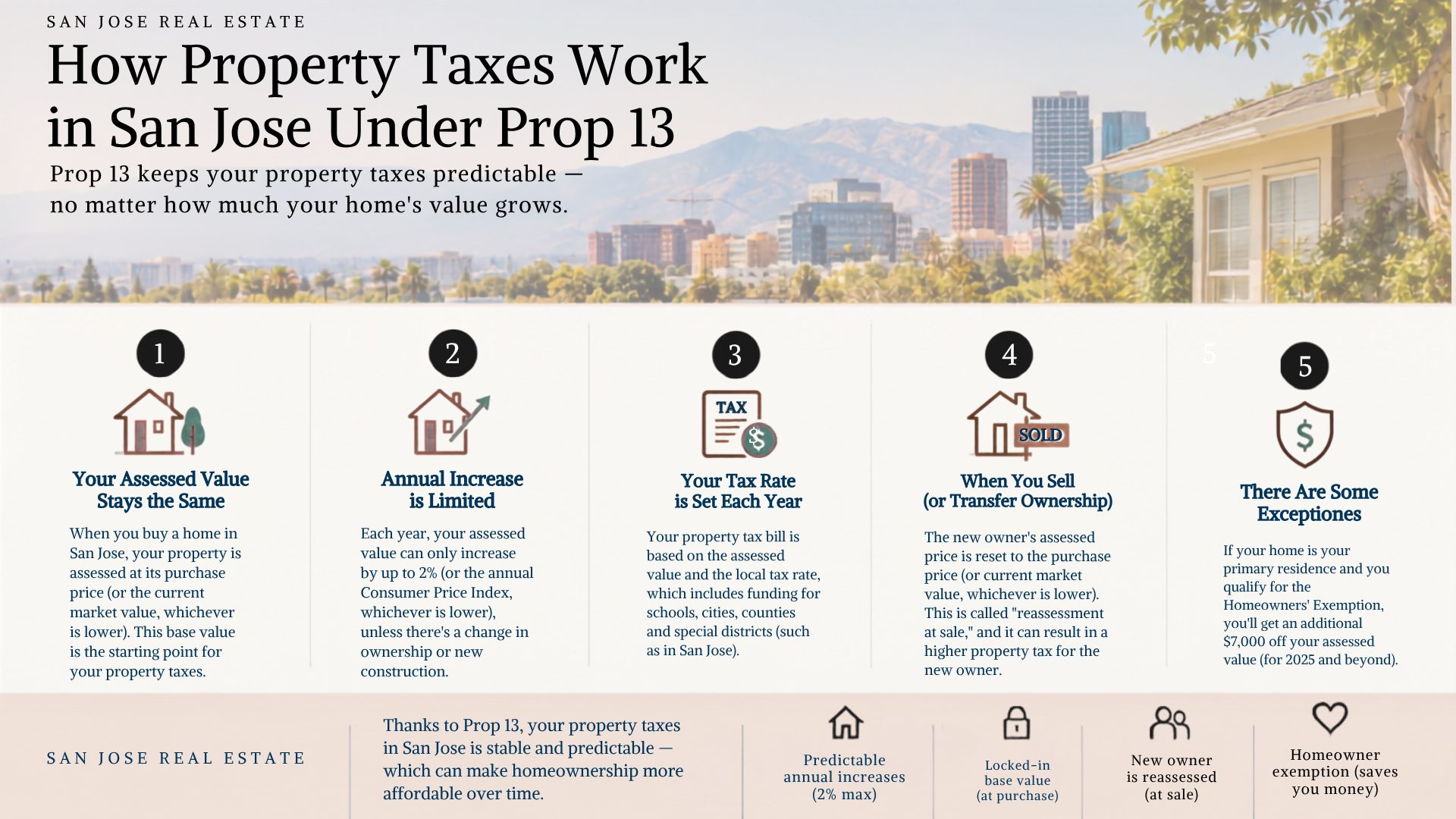
San Jose property taxes are so high because taxes are calculated directly from high real estate purchase prices combined with voter-approved local assessments. Because home values in San Jose are among the highest in the country—frequently exceeding $1.3M to $1.5M—applying even a standard ~1.2% rate resets a new buyer's tax basis to full market value, resulting in annual property tax bills that easily reach $15,000 to $20,000+ per year. That is a hard pill to swallow when you buy a new home, but the good news is that Proposition 13 limits your property tax increases to a maximum of 2% per year with a few exceptions. This is a win that protects homeowners from sudden tax spikes during a boom year... let me explain.
About the Author: Michelle Elliott is a Realtor with Coldwell Banker Realty (DRE# 01777533) specializing in Willow Glen, Cambrian Park, Almaden, and Downtown San Jose, with 20+ years of experience and over $235M in lifetime sales volume. Ranked top 1.5% Nationwide [RealTrends] and top 5% in Santa Clara County, she has been featured on KTVU Fox 2 and co-hosts Say What You Want About Real Estate. Full bio →
Key Takeaways for San Jose Readers:
Takeaway 1: California’s base property tax rate is generally around 1%, but San Jose's high property values result in larger total annual tax bills.
Takeaway 2: The good news is that Proposition 13 protects homeowners by capping the annual increase in a home's assessed value at 2%, meaning long-term owners pay significantly less than recent buyers.
Takeaway 3: Buyers must also account for voter-approved local assessments and potential Mello-Roos taxes, which fund community infrastructure and schools.
If you're moving to San Jose from another state—or even another part of California—you may be surprised when you see the estimated property taxes on a prospective home. The good news is that the tax rate itself isn't unusually high compared to the rest of the country. The bigger reason property tax bills seem so expensive is simple: San Jose homes are worth a lot more than homes in most other real estate markets.
In my experience helping clients buy and sell in Willow Glen, Campbell, and Cambrian over the past two decades, navigating tax expectations is a massive part of the budgeting process. Buyers often experience sticker shock when looking at the monthly breakdown. As a fierce advocate for my clients, I want you to enter the market fully educated so you can avoid surprises and ensure the home you love comfortably fits your long-term financial goals.
Why San Jose Property Taxes Are Driven by Home Prices, Not High Rates
San Jose property taxes are driven by high home values, with the base tax rate sitting relatively low at 1% of the assessed value, plus voter-approved local assessments that bring the total to roughly 1.1% to 1.3%. Compared to many other states, the percentage you pay is actually fairly reasonable. The difference is the asset's underlying value; a 1.2% property tax on a $500,000 home looks vastly different than 1.2% on a $1.8 million property.
The rate hasn't changed, but because you are buying into one of the nation's most valuable real estate markets, the resulting annual tax bill scales accordingly.
-
Key Local Factor 1: When looking at premium zip codes like 95125 in Willow Glen or 95124 in Cambrian Park, factoring in the 1.2% average rate against a $1.5M+ purchase price is critical for establishing your true monthly carrying costs.
-
Key Local Factor 2: To see how these costs balance out across different local markets, you can review our Campbell vs. Willow Glen home buyer comparison or dive deeper into assessment rules in our complete guide to Santa Clara County Proposition 13 property taxes.
How prop 13 May Affect You
High Purchase Prices: With median home prices in San Jose well above $1.3 million, a buyer paying $1,500,000 will see an initial property tax bill of approximately $18,000 to $19,500 per year ($1,500–$1,625/month).
The "Neighbor Disparity" Effect: Longtime owners pay taxes based on what they originally paid years or decades ago, plus a capped maximum increase of just 2% per year. A neighbor whose home is worth $1.5M today might only pay taxes on an assessed value of $300,000 (~$3,900/year), whereas a new buyer pays taxes on the full $1.5M purchase price
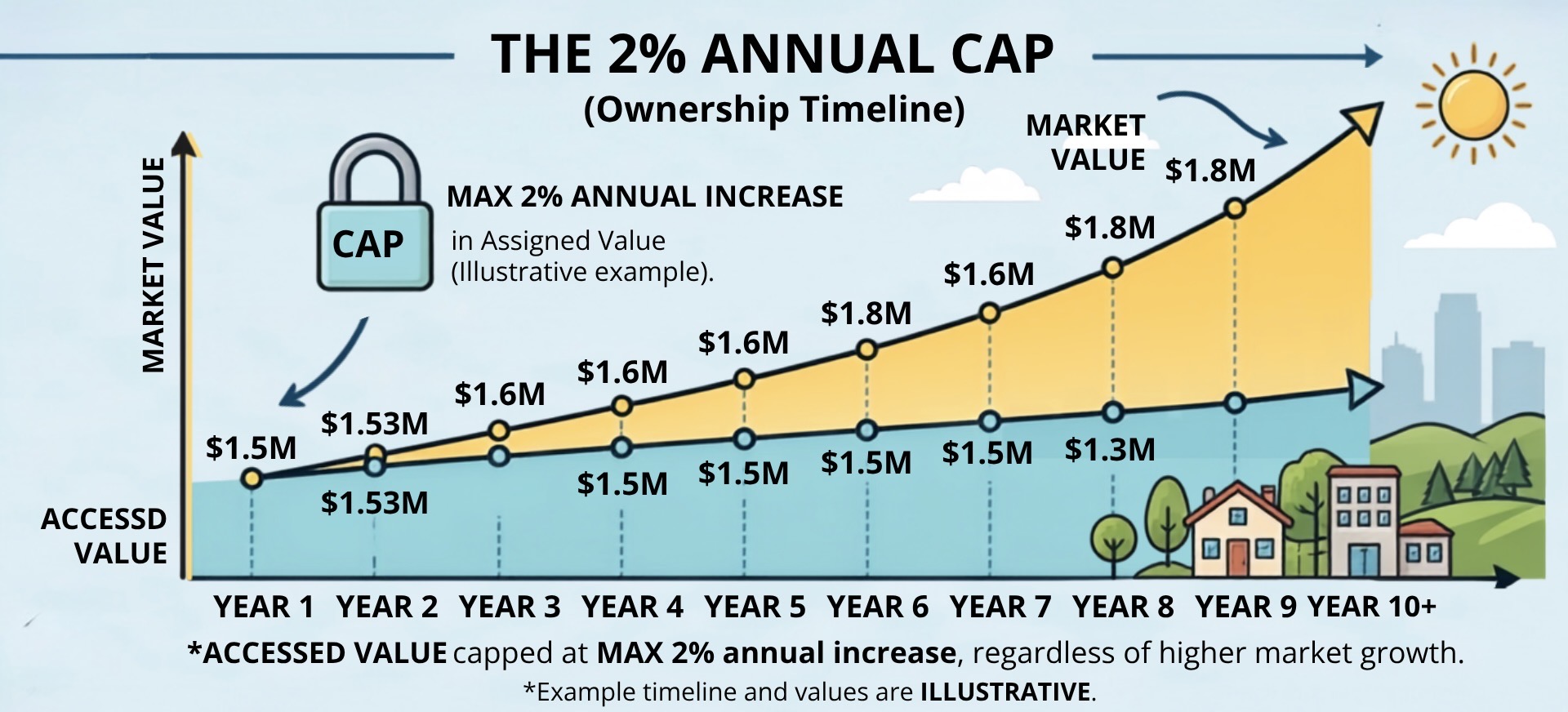
How Proposition 13 and Local Assessments Impact Your Bill
Proposition 13 fundamentally changes how property taxes work in California by limiting the increase of your home's assessed value to no more than 2% per year, regardless of how much the actual market value skyrockets. This means if you buy a home today and hold it for decades, your property taxes remain highly predictable and relatively low compared to what a new buyer would pay for the exact same house next door.
In addition to this base rate, your bill will include voter-approved local assessments that fund our local schools, roads, parks, and public safety infrastructure. Some newer developments may also include Mello-Roos taxes, which are special district assessments used to pay for community improvements. Not every home has Mello-Roos, so it is vital to verify these details during the escrow process.
-
Official Data Verification: Before writing an offer, it is highly recommended to verify current tax rates and understand how your specific property's assessed value is calculated by visiting the official Santa Clara County Assessor's Office
Frequently Asked Questions About San Jose Property Taxes
Do all homes in San Jose have Mello-Roos taxes?
No, not all homes in San Jose have Mello-Roos taxes; they are typically found in newer housing developments and master-planned communities to fund fresh infrastructure. If you are evaluating properties in established neighborhoods in South San Jose, browse active listings on our Cambrian San Jose real estate guide, where older homes generally do not carry these specific assessments.
How are local school districts funded through my property taxes?
A portion of your property tax bill includes voter-approved local bond measures and parcel taxes specifically designed to fund local school district facilities and educational programs. To view school district boundaries and understand local funding initiatives, refer directly to the San José Unified School District portal.

Local San Jose Real Estate Expertise & Next Steps
Navigating the San Jose real estate market requires hyper-local expertise. Whether you're buying or selling in Willow Glen, Cambrian, or Campbell, schedule a personalized strategy call with Michelle Elliott, top San Jose Realtor or search active listings on our San Jose real estate portal.
Downtown San Jose
Almaden