Facebook
 X
X
 Pinterest
 Copy Link
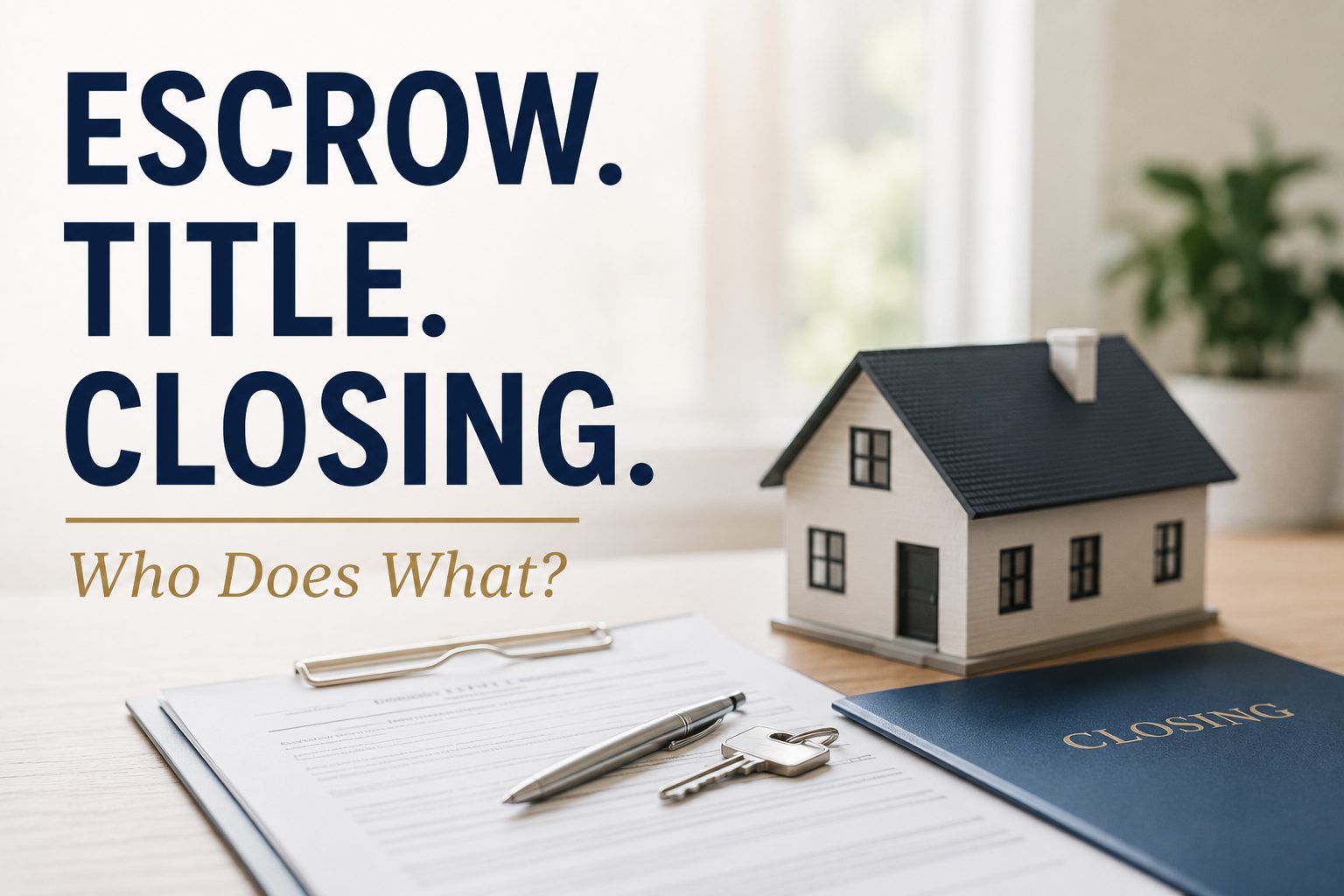
Once your offer is accepted, you start hearing three words constantly:
Escrow. Title. Closing.
They can sound like different names for the same thing.
They’re not.
Each one plays a different role in getting you from an accepted offer to actually owning the home, and understanding who does what can make the whole transaction feel much less mysterious.
If you’re buying in San Jose or elsewhere in Santa Clara County, here’s the plain-English version.
First: What Is Escrow?
Escrow is essentially the neutral middle ground between you and the seller.
Instead of you handing hundreds of thousands of dollars directly to the homeowner and hoping everything goes according to plan, an escrow holder manages the money and documents according to written instructions agreed to in the transaction.
California’s Department of Real Estate describes the escrow company as a neutral third party responsible for protecting the interests of both buyer and seller and ensuring the terms contained in the escrow instructions have been satisfied before the transaction closes.
Think of escrow as the transaction’s traffic controller.
They aren’t there to decide who should win an argument.
They’re there to make sure the agreed steps happen in the right order.
What Does the Escrow Officer Actually Do?
Your escrow officer may handle things such as:
- Receiving and holding your deposit and other funds
- Preparing or coordinating escrow documents
- Following the written escrow instructions
- Prorating certain taxes, interest or other expenses when applicable
- Coordinating with the lender, title company and real estate professionals
- Preparing the final accounting of credits and debits
- Arranging for documents to be recorded
- Paying authorized obligations from escrow
- Disbursing proceeds after closing
California’s Department of Insurance similarly describes escrow as a closing service that handles the funds and documents involved in the transaction and disburses money according to the escrow instructions once the required conditions have been met.
What the Escrow Officer Does Not Do
This distinction matters.
Your escrow officer is not your negotiator.
They’re not there to tell you whether you should accept a seller’s repair response, waive a contingency, increase your offer or walk away from a deal.
For real estate strategy, that’s a conversation with your agent.
For legal advice, that belongs with a qualified attorney.
For mortgage questions, talk with your lender.
The escrow officer stays in the neutral lane.
Then What Does the Title Company Do?
Title is about something different:
Who legally owns this property, and is there anything recorded against it that could interfere with your ownership?
Before issuing title insurance, a title company reviews public records and other title information to identify potential problems such as liens, claims, unpaid taxes, easements, ownership issues or other recorded matters affecting the property.
The title company then provides a preliminary title report or similar title commitment for review.
California’s Department of Insurance says title searches examine records such as deeds, mortgages, judgments, liens, tax records and maps to determine ownership and the condition of title.
Don’t Ignore the Preliminary Title Report
This is one of those documents that can be tempting to skim.
Don’t.
The preliminary title report can show things such as:
- Current ownership
- Existing loans or liens
- Easements
- Covenants, conditions and restrictions
- Tax information
- Other recorded exceptions affecting the property
Not everything listed is automatically a problem.
An ordinary utility easement, for example, may be completely normal.
But you still want to understand what’s attached to the property you’re buying.
If something doesn’t make sense, ask questions before closing.
What Is Title Insurance?
Title insurance protects against certain covered problems involving ownership or title.
It’s different from homeowners insurance.
Homeowners insurance generally protects against future events such as covered property damage.
Title insurance deals primarily with certain title problems that existed before you became the owner but may not become apparent until later.
Examples can include covered issues involving:
- Unknown liens
- Forged documents
- Errors in public records
- Missing heirs
- Undiscovered encumbrances
- Certain ownership claims
The exact coverage depends on the policy, exclusions and endorsements.
There Are Usually Two Different Title Policies
When a mortgage is involved, buyers frequently encounter two separate policies.
Lender’s Title Insurance
This protects the lender’s financial interest in the property.
The lender generally requires it as a condition of financing.
Important:
The lender’s policy protects the lender—not you.
Owner’s Title Insurance
This policy protects the buyer’s ownership interest, subject to the terms and exclusions of the policy.
California’s Department of Insurance specifically notes that a lender’s policy doesn’t protect the homeowner and that buyers who want coverage for their own ownership interest need an owner’s policy.
Why Does One Company Sometimes Seem to Be Doing Everything?
If you’re buying in Northern California, this can be confusing because the title and escrow services are often handled through the same company.
That’s a regional practice.
California’s Department of Insurance notes that in Northern California, title insurance companies tend to handle both title and escrow services in the same transaction, while practices can be different in Southern California.
So you might communicate with one company throughout the transaction even though title work and escrow work are still different functions.
Who Pays for Title Insurance?
Here’s where California gets interesting.
There isn’t one statewide rule requiring the buyer or seller to pay the owner’s title insurance premium.
California’s Department of Insurance says payment is based largely on local custom and negotiation.
Historically, buyers have often paid the owner’s title insurance premium in Northern California, while sellers have more commonly paid it in Southern California. The parties are free to negotiate something different.
The buyer also generally pays for the lender’s title insurance policy when financing is involved.
Your specific purchase agreement controls the allocation in your transaction.
What Are You Actually Paying For?
When you look at your closing statement, you may see several related charges.
Escrow fees pay for the administration of the escrow transaction—handling documents, funds, accounting and closing instructions.
Title insurance premiums pay for the title insurance policies.
Title-related charges may reflect searches, endorsements or other services depending on the transaction and provider.
Recording fees pay for documents that must be officially recorded with the county.
Notary, wire or other administrative charges may also appear depending on your transaction.
One useful buyer tip: title insurance companies in California file rates with the Department of Insurance, and rates can differ between companies. The state specifically encourages consumers to compare title insurance costs and services.
A Historical Fair Housing Issue You May See in Older Records
Older California property records sometimes contain discriminatory restrictive covenants that attempted to limit who could own or occupy property based on race or other protected characteristics.
Those provisions have long been legally unenforceable.
California went further with AB 1466, enacted in 2021, requiring county recorders to establish programs to identify and redact unlawfully restrictive covenants from recorded documents through the state’s restrictive-covenant modification process.
If you ever see old discriminatory language referenced in historical property records, it does not create a valid modern restriction on who can buy or live in the property.
It is a reminder of why today’s Fair Housing protections matter.
Fair Housing Applies Throughout the Transaction
Every buyer deserves equal access to housing opportunities and professional services.
Real estate professionals should not provide different access, advice or treatment based on race, color, religion, sex, disability, familial status, national origin or other characteristics protected under federal, California or local law.
That principle applies from the home search through financing, escrow and closing.
Your transaction should be about the property, contract, financing and your stated goals—not assumptions about who you are or where someone thinks you should live.
What Actually Happens Near Closing?
As you get closer to closing, several pieces come together.
Your lender finishes the loan process.
You’ll sign the required loan and escrow documents.
You’ll send your remaining funds to escrow using independently verified wiring instructions.
The lender funds the mortgage.
The required documents are sent for recording.
Once recording occurs and escrow confirms the transaction is complete, escrow disburses funds according to the instructions.
That can include paying off the seller’s existing loan, paying authorized transaction expenses and delivering the seller’s proceeds.
Then the transaction closes.
A Quick Wire-Fraud Warning
This deserves its own section because buyers are moving large amounts of money during escrow.
Never send money based solely on emailed wiring instructions.
Real estate wire fraud often involves criminals impersonating escrow companies, agents or other parties and sending fake instructions.
Before wiring any money, independently call the escrow company using a verified phone number and confirm the instructions verbally.
If you receive an unexpected message telling you the wiring instructions have changed, treat it as suspicious until you’ve independently verified it.
Who Should You Call When You Have a Question?
A simple way to remember it:
Question about your offer or negotiation?
Call your real estate agent.
Question about your loan or mortgage approval?
Call your lender.
Question about your deposit, escrow funds, signing or closing statement?
Call your escrow officer.
Question about the preliminary title report or title insurance?
Call the title company.
Question requiring legal interpretation or legal advice?
Call an attorney.
Knowing who owns which part of the transaction saves a surprising amount of confusion.
The Bottom Line
Escrow, title and closing aren’t three names for the same thing.
Escrow manages the transaction’s money and documents neutrally according to the instructions.
Title examines ownership and recorded matters affecting the property and provides title insurance.
Closing is the point where all of those pieces come together and the ownership transfer is completed.
Once you understand those roles, that long stretch between “offer accepted” and “here are your keys” starts to make a lot more sense.
If you’re buying a home in San Jose or Santa Clara County, I’ll help you understand who is handling each step, what documents deserve your attention and what questions to ask along the way—so you’re not simply signing papers because someone put them in front of you.
This article is for general educational purposes and isn’t legal, title, escrow or financial advice. Escrow practices, fees and customary allocations vary by transaction and location. Your purchase contract and escrow instructions control your specific transaction.
GET YOUR FREE HOME SELLING BOOK
About the Author – Michelle Elliott
With over 20 years of experience navigating the fast-paced Silicon Valley market, I provide a strategic, results-driven approach to residential real estate. My career is built on a foundation of deep local expertise and a relentless commitment to my clients’ success, resulting in over $235 million in lifetime sales volume and a consistent ranking in the top 3% of agents in Santa Clara County and top 2% at Coldwell Banker. My expertise has been featured on KTVU Fox 2, Real Producers and the Willow Glen Resident. She is also the co-host of the San Jose Podcast “Say What You Want About Real Estate”
A Hyper-Local Expert with Global Reach
I specialize in San Jose, in the neighborhoods of Willow Glen (95125 & 95124) Cambrian Park and Almaden, Downtown San Jose/Japantown (95112) markets. As a certified Luxury Property Specialist with Coldwell Banker Realty, I combine high-end marketing strategies with granular neighborhood knowledge to help my clients achieve premium results.
The “Tiger” at the Negotiating Table
My clients have characterized me as a “tiger” at the negotiating table who remains “sweet and patient” with my clients throughout the process. I pride myself on being a fierce advocate for my buyers and sellers, ensuring the best possible terms in every transaction, and I strive to be the best Realtor in 95125! This balance, drive, and tenacity have earned me consistent 5-star ratings across Google, Zillow, Realtor.com, and Yelp.
Michelle Elliott
Michelle@michelleelliottrealtor.com
1712 Meridian Ave, Ste C, San Jose, CA
DRE 01777533